Low Competition Keywords: Building an SEO Backlog You Can Actually Ship
Low competition keywords only matter when they become reviewed pages. Here's a backlog-driven workflow for founders using coding agents like Claude Code.
You have a working product, a handful of paying customers, and a growth channel that depends on paid ads or word of mouth. Organic traffic is still close to zero. There's no SEO hire, no agency retainer, and your first keyword-research session produces competing dashboards full of volume, KD, CPC, and intent labels that don't agree.
By the end of the afternoon, you've got a spreadsheet with hundreds of terms. Nobody on the team has committed to writing any of them.
That's the failure mode this article addresses. Low competition keywords aren't valuable because they look easy in a tool. They're valuable when someone can turn them into a reviewed page, merge it, get it indexed, and learn from the result. Treat keyword research like a software backlog, with a queue, a scoring rubric, and an execution loop that coding agents can help ship.
Why Most Founders Stall at Keyword Research
A founder can finish keyword research with hundreds of plausible targets and still have nothing ready to ship. The missing piece is usually not more ideas. It is a defined path from query to page, review, merge, and measurement.
Keyword tools return search volume, keyword difficulty, CPC, and intent labels, but those fields do not settle the decision. One tool may rate a phrase easy while another rates it competitively. A commercial query can have modest demand and a clear route to a signup, while a broader informational term attracts attention without matching the product or buyer.
The spreadsheet grows because collecting candidates feels productive. It becomes useful only when each candidate has a page type, an owner, evidence from the SERP, and a next action.
Research creates work, not output
An executable SEO backlog gives a developer enough context to build the page and gives the founder a reason to prioritize it. Record at least:
- Target query: The exact phrase and close variants.
- Search intent: Informational, commercial investigation, or transactional.
- Page type: Comparison, use case, glossary, template, location, or another format.
- Business connection: The feature, workflow, or product capability that addresses the query.
- SERP evidence: The pages ranking now, the apparent strength of their domains, and how closely they satisfy the query.
- Acceptance criteria: Required sections, internal links, metadata, structured data, and conversion path.
That information turns a research row into a build specification. A coding agent such as Claude Code or Cursor can use it to open a pull request, but a disconnected keyword export still requires the team to make every important decision from scratch.
Practical rule: If a keyword has no owner, page type, and next action, it is research residue rather than a backlog item.
The spreadsheet is where SEO goes to wait
A founder may collect a few hundred opportunities and then discover that the first page still needs an unanswered product decision. Should it be a comparison or a tutorial? Does the query come from a buyer, a researcher, or someone seeking a login page? Can the product credibly solve the underlying job?
Reduce the queue before writing. Remove duplicates, group similar queries, inspect the ranking pages, and score each opportunity for business value and SERP beatability. Review those decisions with the team before an agent generates content or code. A smaller queue of approved page opportunities is easier to ship, review, merge, and learn from than a large export nobody owns.
Keyword research works as an input to production, not as the deliverable. Tools find candidates, SERP checks test whether the result can be beaten, and a clear brief gives an agent enough structure to produce a pull request that a human can review.
What Low Competition Keywords Mean
Low competition keywords are not defined by a low difficulty score alone. A score helps filter candidates, but it cannot show whether your domain can produce the page Google expects or whether the visitor has a reason to use your product.
A working definition uses four filters:
- Tool difficulty: Start with terms that may be within reach.
- SERP beatability: Check whether ranking pages are thin, outdated, poorly matched, or supported by weak domains.
- Intent fit: Confirm that the query expresses a job your product can credibly help with.
- Site and buyer fit: Assess your domain's authority, the audience's needs, and the route from visit to signup, trial, or demo.
An analysis of 306 million keywords found that 91.8% of search queries are long-tail terms, while those queries represent only 3.3% of total search volume. Backlinko's long-tail keyword analysis illustrates the gap between the large number of specific opportunities and the modest volume attached to each phrase. That pattern supports publishing for fragmented demand instead of chasing only broad head terms.
A surface definition versus a working definition
Compare "CRM" with "best CRM for solo SaaS founders." The first query may attract broad awareness. The second identifies an audience, evaluation intent, and likely product requirements. Its reported volume may be much lower, yet it can send more commercially useful visitors because the page can answer a specific buying question.
Reported volume cannot settle the decision. The page still needs to beat the SERP and give the reader an appropriate next step.
| Dimension | Surface View, KD Only | Working View |
|---|---|---|
| Difficulty | Pick a low tool score | Use the score as an initial filter, then inspect ranking pages |
| Competition | Count the metric | Judge domain strength, content quality, page format, and intent match |
| Relevance | Choose a related phrase | Map the query to a real product capability or use case |
| Traffic | Prefer larger volume | Prefer qualified demand your page can serve |
| Success | Reach a ranking | Build a credible path to a signup, trial, or demo |
The definition to use in your backlog
A low competition keyword is a query where a credible page from your domain can plausibly reach the top five within three months and convert the visitor into a signup, trial, or demo. This is a decision rule, not a promise. Applying it requires reviewing the target page, the current SERP, and the product path before an opportunity enters the shipping queue.
A term can carry a low KD score and still be useless. "Example brand login" may be easy to rank for, but its navigational intent excludes your product. A term with a higher score may deserve attention when the SERP is weak and the business fit is unusually strong. The useful candidate is the one your team can turn into a reviewed page and a credible next action.
How Keyword Difficulty Scores Get Calculated
Keyword difficulty is a directional estimate of ranking resistance, not a universal measurement. Search Engine Land's explanation of keyword difficulty identifies several inputs that commonly shape the score:
- The number of pages ranking: A crowded result set usually indicates more competition.
- Backlinks to ranking pages: Pages with stronger link profiles are harder to displace.
- Ranking positions: Tools assess which pages hold the strongest positions and how authority is distributed across the results.
- Intent and search volume: Demand and the result format searchers expect affect how a query is evaluated.
Moz describes its Difficulty metric as an estimate of how hard it is to reach the top 10 by analyzing the strength of the top 10 organic blue links, as explained in its Keyword Explorer documentation. The documentation uses a 1 to 100 scale and says the calculation draws on Page Authority and Domain Authority, with an adjustment for projected click-through rate. Moz's keyword difficulty tool provides related metric details.
Tool scores aren't interchangeable
Semrush, Ahrefs, and Moz do not calculate difficulty from identical inputs. Search Engine Land notes that Semrush combines backlink metrics, authority, search volume, SERP features, brand impact, and keyword word count, while Ahrefs focuses mainly on referring domains. Semrush also treats long tail keywords as narrower versions of broader terms, where longer variations, questions, and related terms can have lower volume and competition.
That difference affects how you build a publishing queue. The same query can receive different scores across providers because each tool uses different data, formulas, and assumptions. Do not average those scores into a precise-looking number. Select one provider and use its scale consistently.
| Provider | Primary Inputs | Scale | Typical Bias |
|---|---|---|---|
| Moz | Page Authority, Domain Authority, projected click-through rate | 1 to 100 | Strongly reflects authority of first-page results |
| Ahrefs | Referring domains to ranking pages | 0 to 100 | Emphasizes link requirements |
| Semrush | Backlinks, authority, volume, SERP features, brand impact, word count | 0 to 100 | Blends link, SERP, and query characteristics |
Use one provider consistently
Pick the tool your team can access and record its score without comparing it directly with another provider. If the queue begins in Moz, rank candidates relative to Moz. If it begins in Semrush, keep the Semrush score as the internal reference.
Then inspect the SERP before creating a page brief. A score cannot show whether the top result is an exact-match product page, a thin affiliate article, a forum thread, or a strong guide from an established publication. Review the page types, content quality, domain strength, and intent match. Those observations determine whether a coding agent can draft a useful page for review, or whether the opportunity belongs below the queue.
A Repeatable Workflow for Finding Candidates
A founder can leave a keyword tool with hundreds of suggestions and still have no page ready to ship. The useful workflow turns customer language into a short, reviewed build queue. It combines expansion, SERP inspection, and a handoff that an engineer or coding agent can act on.
Build and expand the seed list
Start with 5 to 10 seed terms drawn from customer interviews, support tickets, and product feature names. For a SaaS product, a seed may describe a job, pain point, integration, or report instead of the category itself.
Expand each seed with modifiers:
- Evaluation: best, vs, alternative, review.
- Audience: for startups, for agencies, for product teams.
- Use case: for churn tracking, for onboarding, for incident response.
- Context: by geography, regulation, platform, or implementation detail.
- Questions: how, what, why, does.
Use free tiers of AnswerThePublic and AlsoAsked where they add coverage, then check autocomplete suggestions through Ahrefs or Semrush. Review longer variations, questions, and related terms rather than treating the head term as the whole opportunity. For a deeper pipeline walkthrough, see this guide to AI SEO keyword research.
Merge the exports, remove terms already covered by your sitemap, and use a 90-day volume window so seasonal noise does not control the queue. Export a CSV with:
keyword, volume, KD, CPC, intent

Validate the SERP manually
Keyword metrics produce candidates, not page briefs. Open the top 10 results for each shortlisted term and record:
- Domain strength: Capture available DR or UR data using the same provider throughout the review.
- Content depth: Check whether each page answers the query fully or only skims it.
- Intent match: Confirm that the result format fits what the searcher wants.
- Page quality: Note outdated information, weak structure, missing examples, and poor conversion paths.
- Result diversity: Look for forums, older posts, thin affiliate pages, or pages aimed at a neighboring intent.
A practical filter is to retain candidates where three of the top ten results have DR under 30 and no clear intent match. Treat that filter as a starting signal, not a ranking guarantee. A weak-looking SERP may still include a brand-driven result or a page type your site cannot reproduce well.
Productionize the weekly run
A weekly pipeline should refresh expansion, clustering, validation, scoring, and queue status. It should not produce another unreviewed spreadsheet. Orchory's AI Keyword Research Tool is one option for organizing the research and handoff.
The output should function as a build queue:
| Keyword | Intent | Page Type | SERP Issue | Product Connection | Status |
|---|---|---|---|---|---|
| Specific use-case query | Commercial | Use case | Thin competing pages | Feature or workflow | Ready for PR |
| Comparison query | Commercial | Comparison | Mixed intent | Alternative capability | Needs review |
| Problem query | Informational | Guide | Strong exact-match pages | Supporting workflow | Watch |
For teams using Claude Code or Cursor, each ready row can become a reviewed pull request with the target query, intent notes, competing URLs, page type, and product evidence attached. That keeps automation behind human review.
The deliverable is pages with enough evidence to build, not a list of keywords to consider.
<iframe width="100%" style="aspect-ratio: 16 / 9;" src="https://www.youtube.com/embed/KjK5-L-wDVg" frameborder="0" allow="autoplay; encrypted-media" allowfullscreen></iframe>Scoring Opportunities Beyond KD
A low-KD keyword can still consume a week of engineering time and produce no qualified visits. Score the page you can ship and win, not just the query you can rank.
I use a 0 to 100 opportunity score with four inputs. The weights keep the queue tied to product value, SERP conditions, and implementation cost.
The four inputs
Intent fit receives 30 points. Score highly when the query describes a job your product solves directly. Reduce the score when the searcher wants education your product cannot support or is looking for another brand.
SERP weakness receives 30 points. Award points when at least three top results have DR under 30, thin content, or no useful schema. Remove points when strong exact-match pages dominate, especially if they demonstrate the workflow better than your planned page. Review SERP formats and feature patterns with a SERP features opportunity workflow before assigning a template.
Business relevance receives 25 points. A keyword connected to a feature, use-case page, or pricing decision should outrank a loosely related educational term. The page needs a credible next action, not merely topical overlap.
Asset cost accounts for 15 points. Begin with the full allocation, then subtract for production difficulty. A programmatic template may need less work than a hand-written guide. A comparison page can require product research, screenshots, and ongoing maintenance.
This model ranks opportunities your team can plausibly win and monetize. It does not forecast traffic.
A worked queue decision
For "saas churn dashboard," one scoring pass might assign intent fit 28, SERP weakness 22, relevance 23, and asset cost 10, producing an opportunity score of 83. Its raw KD may look less attractive than an easier keyword, yet the query connects directly to a product workflow.
A keyword with a KD headline of 42 may score only 51 when HubSpot and Mixpanel dominate the SERP, intent is partly aligned, and the required asset is expensive. A lower KD cannot offset poor business fit and capable competitors.
The figures below show a spreadsheet structure, not universal scores.
| Keyword | KD | Intent Fit | SERP Weakness | Relevance | Asset Cost | Opportunity Score |
|---|---|---|---|---|---|---|
| saas churn dashboard | 42 | 28 | 22 | 23 | 10 | 83 |
| Broad category term | 18 | 15 | 8 | 18 | 10 | 51 |
Use Orchory Free SEO Tools beside your existing research process when you need a separate place to inspect or organize SEO inputs. The queue still requires a product decision, SERP review, and clear page specification.
Attach those inputs to each approved row. Claude Code or Cursor can then turn the row into a draft pull request, while a reviewer checks the intent, competing URLs, page type, and product evidence before merge. That converts keyword research into a reviewed shipping queue.
Why Long Tail Wins or Loses on Intent
Query length alone says little about query quality. A specific phrase can describe a buying problem, or it can express a narrow curiosity with no path to a product decision.
An analysis by Neil Patel reported conversion rates of 0.17% for one-word keywords, 0.35% for two-word keywords, 1.02% for three-word keywords, and 1.94% for six-word keywords. The keyword-length conversion analysis shows the directional relationship, but length remains only a proxy. Longer queries tend to carry more intent when they name a problem, audience, constraint, or desired outcome.
Classify intent before choosing the page
Sort candidates into three practical buckets:
- Informational: The searcher wants an explanation, definition, or process.
- Commercial investigation: The searcher is comparing tools, methods, or vendors.
- Transactional: The searcher is ready to take an action or evaluate a purchase.
Then inspect the SERP beside your product. "How to calculate SaaS churn" may call for an educational guide, while "SaaS churn dashboard" may support a product-led use-case page. Both phrases are specific, yet they require different page types, evidence, and conversion paths.
A short page can satisfy a narrow informational query immediately and leave little reason to continue. A deeper commercial page has more room to show the workflow, compare options, address constraints, and offer a credible next step. That extra scope only helps when it matches what the SERP already rewards.
Search length is a clue, not a verdict. Intent decides whether the page earns business value.
Choose a query whose SERP contains weak pages and whose intent your product can serve credibly. Review the competing URLs, identify the job behind the search, and define the page before asking an agent to build it. A long phrase alone does not justify another URL. The opportunity exists when your site can complete that specific job better than the current results.
Shipping the Queue as Pull Requests
A keyword queue earns its place when each row becomes a reviewable engineering task. The handoff should preserve the reasoning behind the opportunity, not just pass a phrase to an agent.
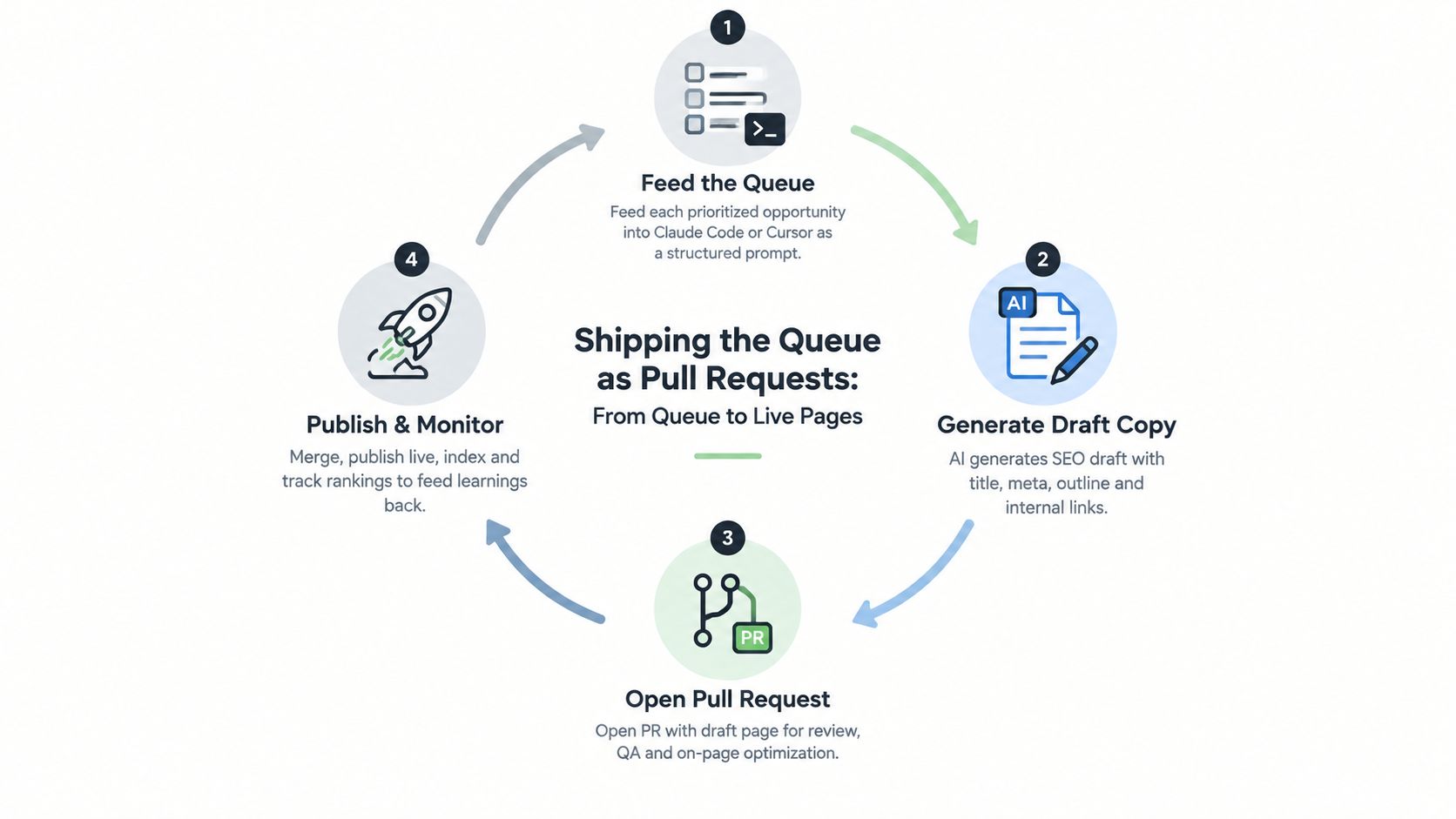
For each candidate, create a structured prompt for Claude Code or Cursor. Include the target query, intent, page type, SERP weaknesses, required sections, verified product facts, internal-link targets, metadata, schema requirements, acceptance criteria, and the repository location. Specify which existing components and templates the agent should reuse. This keeps programmatic publishing tied to the SERP job and the codebase.
Use the agent for production, not judgment
The coding agent can draft and implement the page. The team still decides whether the page deserves to exist and whether its claims are accurate. Ask the agent to:
- Create the page structure: Add the route, title, meta description, headings, and canonical behavior.
- Draft for the SERP intent: Complete the searcher's job instead of repeating the keyword.
- Add internal links: Connect the page to relevant product, feature, comparison, and guide pages.
- Implement structured data: Use schema only when it accurately describes the page.
- Open a pull request: Keep the change isolated, reviewable, and easy to revert.
Review the PR like a product change
A polished draft is not a merge criterion. Review the pull request against the page's search job and business role:
- Intent: Does the page use the format the SERP rewards?
- Accuracy: Are product capabilities, integrations, and limitations correct?
- Original value: Does it add examples, decisions, or workflow detail missing from competing pages?
- On-page SEO: Do the title, meta description, headings, links, and URL describe the same page?
- Technical quality: Does it render through the intended template without duplicate content?
- Conversion path: Is the next step appropriate for the reader's evaluation stage?
After merging, publish the page and monitor indexing, impressions, clicks, and position in Google Search Console. Feed those observations into the next queue review. Impressions without clicks usually point to a title or SERP-alignment problem. Clicks without product action can indicate a mismatch between the page's intent and its conversion path.
SEO shipping becomes visible in the repository. Fifty well-scored opportunities turned into fifty reviewed pull requests are more valuable than five hundred ideas trapped in a spreadsheet.
Orchory turns keyword expansion, clustering, SERP validation, opportunity scoring, and prompt handoff into a repeatable queue for coding agents. Visit Orchory to connect the next low competition keyword opportunity to a reviewed pull request.
FAQs
What is a low competition keyword?
Why do keyword tools give different difficulty scores for the same term?
Does a low KD score mean a keyword is worth targeting?
Does a longer keyword automatically mean higher intent?
How do you turn a keyword backlog into shipped pages?